Halvex Pest InterventionCHalvex Pest InterventionC

Subterranean Termite Treatment Chattanooga

Eastern subterranean termites (Reticulitermes flavipes) cause structural timber degradation across Hamilton County due to high annual rainfall and dense clay soils that retain ground moisture. Properties nestled…
Get My Free Estimate →(615) 752-5977
Subterranean Termite Treatment in Chattanooga, TN
Quick answer
  • Scope: Complete foundation perimeter trenching, sub-slab drilling, and exterior bait station installation targeting Eastern subterranean termites.
  • Response Time: On-site structural assessments in Hamilton County within 24 to 48 hours of initial inquiry.
  • Cost: Foundation perimeter spot treatments start at a $200 minimum; full perimeter liquid barriers average $800 to $2,500 depending on linear footage.
  • Safety Profile: Formulations bind directly to the soil matrix once cured, presenting zero vapor transfer to indoor domestic animals or living spaces.
  • Scheduling: Service is arranged by phone at (615) 752-5977 with a physical on-site evaluation to confirm total foundation measurements.

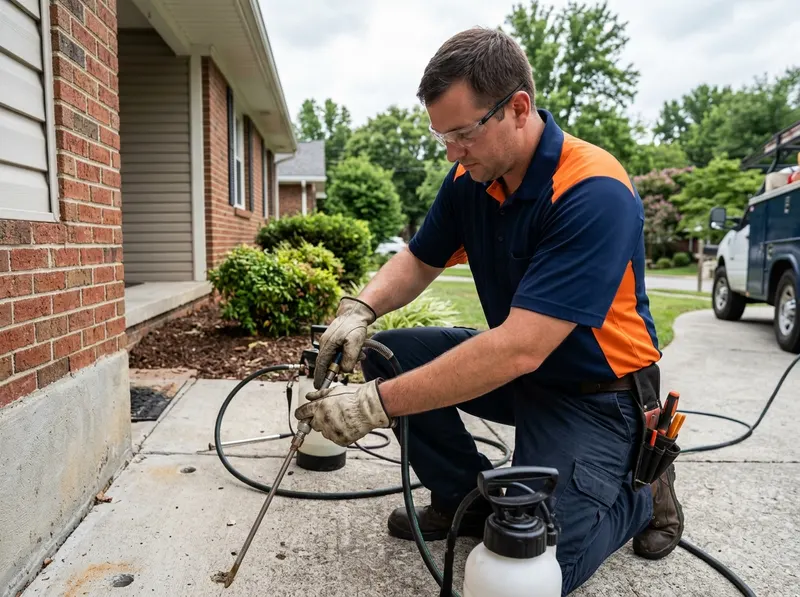
Eastern subterranean termites (Reticulitermes flavipes) cause structural timber degradation across Hamilton County due to high annual rainfall and dense clay soils that retain ground moisture. Properties nestled against Lookout Mountain, historic crawlspace designs in St. Elmo and Highland Park, and concrete slab foundations throughout Brainerd and East Brainerd require continuous defensive perimeters. Subterranean colonies live beneath the soil line and access structural framing through mud shelter tubes constructed over masonry footings. A liquid barrier treatment establishes a continuous zone of non-repellent termiticide by trenching four to six inches into the soil along exterior foundation walls and injecting material directly into backfilled earth at a standard rate of 4 gallons per 10 linear feet. For structures with attached garages, porches, or monolithic slabs in neighborhoods like Hixson and Red Bank, technicians drill 0.5-inch holes spaced 12 inches apart through interior slabs to saturate underlying fill material before patching the access ports.

Selecting between continuous liquid soil barriers and monitored bait systems depends directly on foundation engineering and soil hydrology. Liquid soil barriers fit properties with accessible perimeters where continuous mechanical trenching can reach the footings, providing immediate mortality as foraging workers transfer the active ingredient throughout the subterranean colony. Bait stations fit properties bordering steep topography or sensitive waterways near the Tennessee Riverpark and North Shore where continuous liquid trenching encounters sandstone ledge, tree roots, or zero lot lines. The trade-off centers on intervention speed versus installation disruption: liquid applications yield colony disruption within days but require physical perimeter excavation, while baiting arrays avoid concrete drilling entirely but rely on natural termite foraging cycles to eliminate the central colony over 60 to 90 days. Homes with fieldstone foundations in Riverview or expansive additions in Belvoir often integrate both methods to establish immediate structural perimeter defense while monitoring surrounding yard pressure.

Subterranean Termite Treatment cost in Chattanooga

Targeted Trenching & Localized Foundation Spot Barrier$200 - $450
Full Exterior Liquid Perimeter Barrier (150-200 linear ft)$850 - $1,600
Monitored Subterranean Baiting Station System Installation$950 - $1,800
Comprehensive Combined Barrier & Crawlspace Treatment$1,500 - $2,900

Every job gets a firm, written price after a free on-site visit.

Common questions

How long does a liquid subterranean termite treatment last in Chattanooga?
Non-repellent liquid termiticides provide active structural protection for 5 to 8 years in Chattanooga soil conditions before normal environmental degradation requires reapplication.
What is the structural difference between subterranean termites and carpenter ants in Chattanooga?
Subterranean termites consume wood cellulose and leave soil residue inside galleries, while carpenter ants merely excavate wood for nesting and leave fine wood shavings beneath exit holes.
Will subterranean termite treatment treatments in Chattanooga harm indoor pets?
Exterior soil treatments and locked subterranean bait stations do not off-gas volatile compounds into indoor air, keeping living spaces completely secure for domestic animals.
Are annual ongoing contracts required for subterranean termite treatment in Chattanooga?
Perimeter barrier applications do not require mandatory ongoing monthly service subscriptions, though periodic annual inspections ensure soil barriers remain undisturbed by landscaping.
How does Chattanooga rainfall affect subterranean termite activity?
Chattanooga receives over 50 inches of rainfall annually, which saturates topsoil and drives subterranean colonies upward into contact with subfloor timbers and framing lumber.
Helpful resources

Trusted references & local links

USA.gov, government & consumer helpBetter Business BureauFTC Consumer AdviceU.S. Small Business AdministrationReady.govU.S. EPAENERGY STARU.S. Dept. of EnergyConsumer.govU.S. Census BureauGoogle Maps, Chattanooga, TN

Get started today

Tell us about your subterranean termite treatment job in Chattanooga and we'll send a clear, written quote, usually the same day.

Get your free pest control service quote, Chattanooga

We only use your ZIP to check availability, no spam.