Halvex Pest InterventionCHalvex Pest InterventionC

Crawl Space Encapsulation Pest Defense Chattanooga

Crawl space encapsulation pest defense addresses the primary driver of subfloor infestations in the Tennessee River basin: uncontrolled relative humidity. In river-adjacent zones like North Shore, Riverview, and along…
Get My Free Estimate →(615) 752-5977
Crawl Space Encapsulation Pest Defense in Chattanooga, TN
Quick answer
  • What is included: 12- to 20-mil puncture-resistant ground vapor barrier, structural foundation vent sealing, subfloor joist borate wood treatment, and continuous perimeter insect exclusion barriers.
  • Deployment speed: Diagnostic crawl space inspections deploy within 24 to 48 hours, with physical installation taking 1 to 3 business days depending on square footage.
  • Cost range: Ballpark costs run between $1,500 and $8,500 based on crawl space dimensions and required moisture mitigation, with a firm minimum service fee of $200 confirmed via on-site evaluation.
  • Targeted organisms: Eradicates and bars subterranean termites, camel crickets, Argentine ants, German cockroaches, Norway rats, and house mice from entering the living envelope.
  • Scheduling process: On-site evaluations are scheduled directly through (615) 752-5977, followed by a mapped structural crawl plan.

Crawl space encapsulation pest defense addresses the primary driver of subfloor infestations in the Tennessee River basin: uncontrolled relative humidity. In river-adjacent zones like North Shore, Riverview, and along the Tennessee Riverpark, ambient ground moisture routinely drives crawl space relative humidity past 70%. This saturated microclimate softens wood substructures, inviting fungal decay, wood-boring beetles, and subterranean termites. Concurrently, high-moisture air attracts aggregations of camel crickets, oriental cockroaches, and rodents looking for thermal shelter. Traditional open-vent foundation designs allow continuous pest access while pulling humid air straight up through subfloors via the stack effect, carrying particulate allergens and insect debris directly into living quarters.

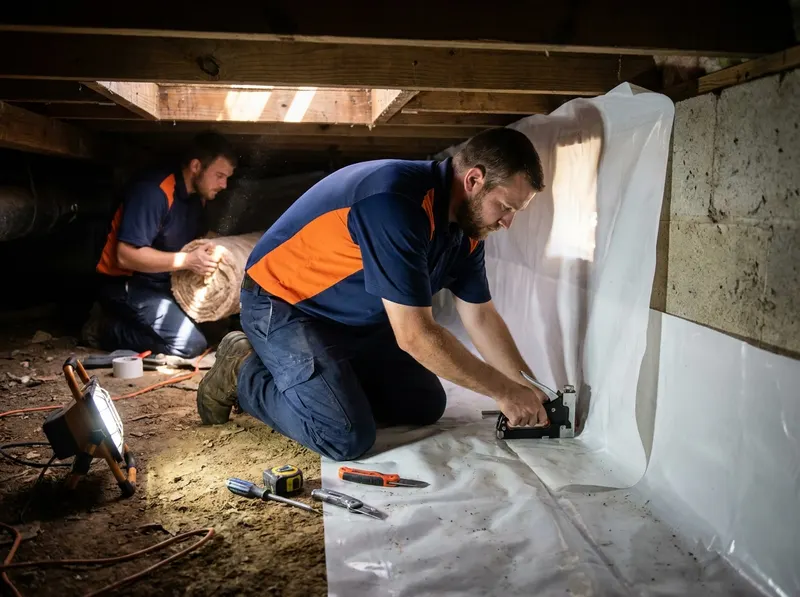
Encapsulating the crawl space alters this biology entirely. The installation process lays a seamless, reinforced 12- to 20-mil polyethylene vapor barrier across 100% of the exposed dirt floor, overlapping seams by 12 inches and sealing them with heavy-duty acrylic tape. Technicians fasten the membrane 6 inches up masonry foundation walls and support piers, leaving a precise 3-inch inspection gap at the top to maintain code-compliant visual termite detection channels. Foundation vents, rim joist gaps, and exterior plumbing penetrations receive expanding polyurethane closed-cell foam and galvanized steel hardware mesh, physically blocking rodents from gnawing their way into the crawl space.

Decision guidance dictates that standard open-vent insecticide dusting works temporarily for isolated surface ant infestations, but homes with documented joist moisture content exceeding 18% require full encapsulation pest defense. The trade-off centers on upfront capital investment versus systemic structural failure: basic surface fogging requires indefinite reapplication every 90 days without stopping wood rot, whereas permanent encapsulation stops subterranean moisture migration, starves damp-loving insect colonies, and drops interior pest migrations without recurring chemical saturation. Properties located on clay-heavy, low-drainage soils in Brainerd, Belvoir, Highland Park, and St. Elmo gain direct protection against seasonal water pooling beneath floorboards.

Work sequences follow a four-stage process: 1. Technicians clear biological waste, old fiberglass insulation, and structural debris from the dirt floor. 2. Specialists execute targeted spray applications of disodium octaborate tetrahydrate onto exposed floor framing to eliminate fungus and wood-destroying insects. 3. Installers anchor the continuous vapor barrier across the ground and up all masonry piers. 4. Crews seal every exterior penetration, vent, and rim joist before introducing an automated crawl space dehumidifier calibrated to sustain subfloor humidity levels below 55%.

Crawl Space Encapsulation Pest Defense cost in Chattanooga

Initial Crawl Space Pest Diagnostic & Moisture Level Reading$200
Targeted Subfloor Pest Barrier & Vent Exclusion (Under 1,000 sq ft)$1,500 - $3,200
Standard Crawl Space Encapsulation with Perimeter Defense (1,000 - 2,000 sq ft)$3,200 - $5,800
Full Heavy-Mil Encapsulation, Joist Treatment & Commercial Dehumidifier System$5,800 - $8,500

Every job gets a firm, written price after a free on-site visit.

Common questions

How does crawl space encapsulation pest defense prevent termite infestations in Chattanooga?
Encapsulation prevents subterranean termites by eliminating the excess moisture they require to survive in subfloor timbers, while technicians leave a mandatory 3-inch bare masonry inspection line below the sill plate to verify no termite mud tubes bypass the barrier.
Will encapsulation trap pest control treatments inside a Chattanooga home?
No, encapsulation seals off the living area from the ground, ensuring all targeted borate treatments and perimeter termiticides remain contained under the vapor barrier and away from household living spaces.
Can mice and rats chew through the vapor barrier installed under Chattanooga properties?
Rats and mice cannot easily penetrate the reinforced 12- to 20-mil multi-ply polyethylene barriers, and all perimeter structural openings are reinforced with 1/4-inch galvanized hardware cloth to physically stop rodent teeth before they reach the liner.
How quickly do camel crickets disappear after crawl space encapsulation in Chattanooga?
Camel crickets generally die off or abandon the crawl space within 7 to 14 days following encapsulation, as the installation of a closed barrier and commercial dehumidifier eliminates the standing humidity and mold spores that comprise their primary food source.
Does Hamilton County building code require crawl space insulation to be removed during pest encapsulation?
Hamilton County guidelines recommend removing falling, pest-soiled fiberglass batt insulation from crawl space joists because wet insulation harbors rodent nests and roach egg cases, which are replaced by rigid foam wall insulation or conditioned air controls.
Helpful resources

Trusted references & local links

USA.gov, government & consumer helpBetter Business BureauFTC Consumer AdviceU.S. Small Business AdministrationReady.govU.S. EPAENERGY STARU.S. Dept. of EnergyConsumer.govU.S. Census BureauGoogle Maps, Chattanooga, TN

Get started today

Tell us about your crawl space encapsulation pest defense job in Chattanooga and we'll send a clear, written quote, usually the same day.

Get your free pest control service quote, Chattanooga

We only use your ZIP to check availability, no spam.